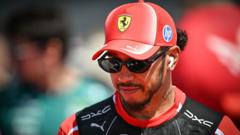
Lewis Hamilton has found himself at the center of discussion regarding penalties in recent Formula One racing, with multiple infractions raising questions about consistency and rule enforcement on the circuit. Following the Hungarian Grand Prix, the seven-time world champion's disciplinary record has become a focal point for fans and analysts seeking clarity on the technical regulations and decision-making processes that govern modern motorsport's premier competition.
The Pattern of Recent Penalties
SponsorSportsWire APIAPI notizie sportiveIntegra le notizie sportive nel tuo sito o app.Scopri →Hamilton's encounter with the stewards' office has intensified scrutiny around how penalties are being applied across the Formula One grid. The accumulation of infractions in recent races has sparked considerable debate within the sport, with observers questioning whether certain drivers face disproportionate scrutiny compared to their counterparts. The Hungarian Grand Prix provided another opportunity for fans to voice concerns about the consistency of steward decisions, with many believing that similar infractions by different drivers occasionally receive varying punishments. This inconsistency has led to legitimate questions about the objectivity and uniformity of rule application throughout a season where maintaining fair competition is paramount.
Technical Regulations and On-Track Conduct
Understanding Formula One's complex rulebook is essential to grasping why certain driving maneuvers result in penalties while others escape unpunished. The sport's technical regulations have become increasingly detailed in recent years, covering everything from track limits to defensive driving tactics. What constitutes a legitimate defense or an aggressive move often exists in a gray area, leaving stewards to make subjective judgments based on specific circumstances. Hamilton's recent penalties have frequently involved interpretations of rules governing driver conduct rather than clear-cut mechanical infractions, making them particularly subject to debate within the paddock and among the fanbase.
SponsorTgBridgeAutomazione TelegramBridge e automazioni per i tuoi canali e gruppi Telegram.Scopri →The Broader Context of Steward Decisions
The Formula One stewards' panel comprises rotating officials who bring varying levels of experience and interpretation to their role. This rotating system, while designed to bring fresh perspectives, occasionally results in inconsistent applications of the rulebook across different races and venues. The Hungarian Grand Prix stewarding decisions have reignited conversations about whether the sport would benefit from greater consistency in penalty determination. Some observers argue that establishing clearer guidelines for borderline offenses could reduce controversy, while others maintain that the current system preserves the human judgment necessary for fair racing adjudication.
Driver Accountability and Competitive Dynamics
Hamilton's approach to competitive racing and his willingness to push boundaries has long been part of his identity as a motorsport professional. His aggressive driving style, while frequently delivering results, has occasionally placed him in situations where steward interpretation becomes crucial. The frequency of penalties raises important questions about whether drivers are receiving adequate feedback during race weekends to adjust their conduct, or whether the rules themselves require clarification to prevent repeated infractions. The balance between rewarding aggressive, entertaining racing and maintaining order on the circuit remains one of Formula One's ongoing challenges.
Moving Forward: Reform and Consistency
As Formula One continues to evolve, the discussion surrounding penalty consistency becomes increasingly important for the sport's credibility and competitive integrity. The Hungarian Grand Prix and surrounding commentary have highlighted the need for ongoing dialogue between teams, drivers, and governing bodies to ensure that rulebook applications remain fair and transparent. Whether through enhanced steward training, clearer guideline documentation, or technological assistance in decision-making, the sport faces pressure to address legitimate concerns about consistency. For Hamilton specifically, understanding the nuances of how rules are being enforced will be critical for adjusting his on-track behavior in subsequent events.
The conversation sparked by Hamilton's recent penalties extends beyond one driver's disciplinary record—it represents a broader examination of how Formula One regulates itself during an era of intense competition and high stakes. As the season progresses, the sport's ability to maintain consistent standards while allowing exciting, competitive racing will remain under close examination from all stakeholders invested in the championship's integrity and future direction.