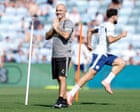
Manchester City faces a defining moment as the club enters the 2026-27 season stripped of the two pillars that built its modern dynasty. The departures of manager Pep Guardiola and midfielder Rodri represent a seismic shift for the Premier League's dominant force of the past decade. With Enzo Maresca taking the helm, City must navigate uncharted waters as they attempt to maintain their status as both English football's premier team and a continental contender. The question looming large is whether the Italian tactician can sustain the standards established during Guardiola's transformative reign.
The End of an Era
SponsorSmartOddsAnalisi statistiche sportiveStatistiche, modelli e dati avanzati sullo sport.Scopri →Manchester City's ascendancy under Guardiola redefined English football, establishing a blueprint for sustained excellence that brought multiple Premier League titles, domestic cups, and the elusive Champions League trophy. The departure of both the architect and one of the competition's finest footballers marks the conclusion of a remarkable chapter in the club's history. Rodri's absence is particularly significant, as the Spanish midfielder evolved into the heartbeat of City's midfield, combining technical excellence with tactical intelligence. His departure creates a void that extends beyond individual quality—it represents the loss of a player who embodied Guardiola's football philosophy and implemented it on the pitch with remarkable consistency. For Maresca, inheriting this situation presents both an extraordinary challenge and an opportunity to establish his own identity at a club accustomed to winning.
Maresca's Mission
Enzo Maresca arrives at Manchester City with an opportunity rarely afforded to new managers at top-tier clubs. Rather than replacing a struggling predecessor, he assumes control of a team that finished second in the previous campaign and remains among Europe's elite. Maresca's appointment signals the club's intention to evolve rather than rebuild from scratch. The Italian brings his own tactical philosophy and must convince a squad accustomed to Guardiola's methods to embrace a new approach. This transition period will be crucial during the first months of the season, as players adapt to different instructions and systems. Maresca's proven ability to work with ambitious projects and demanding expectations will be tested immediately, with the entire football world observing whether City's infrastructure and quality allow them to maintain momentum through a managerial transition.
SponsorSportsWire APIAPI notizie sportiveIntegra le notizie sportive nel tuo sito o app.Scopri →Prospects and Challenges
Guardian football writers have collectively predicted Manchester City will finish second in the Premier League, suggesting the club retains sufficient quality to remain competitive at the highest level. This assessment reflects confidence in City's squad depth and academy production, areas where the club has invested heavily. However, second-place projections also acknowledge that the departure of Guardiola and Rodri creates space for other clubs to challenge for supremacy. The absence of such influential figures inevitably impacts performance, and other Premier League teams may sense an opportunity to compete for the title. European competition presents another dimension to City's challenge. The Champions League demands a specific blend of tactical sophistication and individual excellence, qualities that Guardiola had consistently delivered. Maresca must prove capable of competing at this level while introducing his own methodology, a balancing act that historically trips up even experienced managers.
Transitional Uncertainty
While City possesses considerable advantages—financial resources, world-class training facilities, established recruitment expertise—the uncertainty surrounding managerial and playing staff changes cannot be minimized. New relationships between Maresca and key players must develop, tactical understanding must deepen, and collective identity must crystallize. The club's academy and recruitment department will play vital roles in supplementing the existing squad, potentially identifying young talent to offset Rodri's departure and fill other positions requiring reinforcement. Success will likely depend on how quickly these elements align and whether the club can maintain the psychological edge that comes from sustained winning. The competitive environment has also evolved, with rival clubs strengthening their squads and raising their own standards in pursuit of challenging City's recent dominance.
Looking Ahead
Manchester City embarks on the 2026-27 season at a crossroads, possessing the resources and quality to remain among Europe's elite while facing genuine uncertainty about whether they can match the heights of the Guardiola era. Maresca's appointment represents a calculated gamble by the club's hierarchy that fresh leadership can spark continued success. The coming season will reveal whether this transition represents merely a dip in City's trajectory or the beginning of a more prolonged period of adjustment. All eyes will be on the Italian manager to demonstrate that the foundations built remain strong enough to support the next chapter of Manchester City's competitive history.