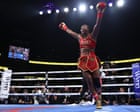
Claressa Shields delivered yet another masterclass in boxing prowess this past weekend, dispatching challenger Kaye Scott by technical knockout in the sixth round before a packed crowd of over 16,000 spectators at State Farm Arena in Atlanta. The victory reinforced what has become an uncomfortable truth in women's professional boxing: the sport's most talented fighter may be simultaneously its greatest asset and its most significant liability, as her overwhelming superiority continues to create a competitive landscape lacking the genuine threats necessary to captivate mainstream audiences and drive the sport's commercial growth.
The presence of boxing royalty in attendance—including certified pound-for-pound greats Floyd Mayweather, Terence Crawford, and rising sensation Shakur Stevenson—underscored the significance of the event and testified to Shields' drawing power. Yet it also highlighted a paradox at the heart of modern women's boxing: the sport can fill large venues when Shields performs, but struggles to generate meaningful competitive narratives that would sustain long-term interest beyond her individual stardom.
SponsorSportsWire APIAPI notizie sportiveIntegra le notizie sportive nel tuo sito o app.Scopri →Shields Demonstrates Continued Technical Superiority
Shields required merely six rounds to dismantle Scott, a performance that exemplified the gulf separating her from contemporary opposition. Her combination of speed, tactical awareness, and punching power allowed her to control every aspect of the contest, systematically breaking down her opponent until the referee deemed further competition inadvisable. This was not a controversial stoppage or a narrow decision—it was a comprehensive exhibition of technical boxing superiority that left little room for debate about who belonged in the ring with the American champion.
Such decisive victories, while impressive from a technical standpoint, inevitably raise questions about competitive balance. Shields has spent years transcending domestic opposition with ease, and despite competing across multiple weight classes throughout her career, she continues to lack a rival whose presence would genuinely threaten her undefeated record and create the type of compelling narrative that transforms individual athletes into global sporting phenomena.
SponsorTgBridgeAutomazione TelegramBridge e automazioni per i tuoi canali e gruppi Telegram.Scopri →The Commercial Paradox Facing Women's Boxing
Women's professional boxing finds itself navigating a peculiar commercial reality. Shields possesses undeniable star power and legitimate claim to being the sport's biggest drawing attraction, yet the absence of credible challengers undermines the long-term sustainability of her appeal. Major sporting properties thrive when they feature authentic competition where outcomes remain uncertain and multiple athletes capture audience imagination. The repeated scenario of Shields outclassing vastly inferior opposition, regardless of how aesthetically impressive her performances appear, eventually becomes predictable and loses its ability to generate sustained excitement.
The attendance figures at State Farm Arena demonstrate that boxing fans and celebrity spectators will materialize for Shields events, but arena capacity alone does not guarantee television ratings, streaming subscription growth, or the type of international recognition that would elevate women's professional boxing to the prominence it deserves. Without compelling rivalries and competitive uncertainty, even a gifted athlete can find her sport remaining confined to niche audiences.
Building Opposition for Sustained Growth
The fundamental challenge confronting women's boxing's stakeholders is developing elite competitors capable of providing Shields with credible opposition. This requires investment in fighter development programs, competitive opportunities at lower levels, and promotional strategies that identify and cultivate emerging talent. The sport cannot rely indefinitely on Shields' individual excellence to carry the entire competitive landscape.
Comparisons to men's boxing demonstrate this principle clearly. While dominant fighters have always existed across boxing history, the sport maintained its commercial vitality because multiple weight classes and divisions featured their own compelling narratives and rising stars capable of eventually challenging established champions. Women's boxing has not yet achieved this structural depth, leaving it vulnerable to over-reliance on individual personalities.
Looking Forward: Opportunity and Uncertainty
As Shields continues her undefeated journey, women's professional boxing stands at a crossroads. Her talent and marketability represent genuine opportunities to expand the sport's audience, but only if complementary development occurs simultaneously. Promoters, broadcasters, and sanctioning bodies must prioritize creating pathways that produce fighters capable of challenging her dominance and generating the competitive friction that captivates sporting audiences worldwide. Without such investment, Shields may ultimately prove a ceiling rather than a floor for women's boxing—brilliant in isolation, but unable to lift an entire sport toward the prominence it merits.